Daniel OS is a personal portfolio assistant that runs its generative model in the visitor’s browser. It combines a verified profile index, a cited entity index, optional public retrieval, a personalized language model for conversational synthesis, browser speech recognition, and local speech output. The goal is to make the portfolio queryable without allowing personalization to distort ordinary technical knowledge.
This post separates what is implemented from what is planned. The LLM was fine-tuned and evaluated. The current speech layer uses browser APIs; it is not a custom-trained STT model or a clone of my voice. A reproducible STT data, fine-tuning, and evaluation pipeline now exists in the repository, but its checkpoint will not replace the browser API until real multi-speaker data and browser tests pass.
Building a source-grounded profile
I began with claims from my CV, portfolio, LinkedIn profile, publications, GitHub, and Hugging Face account. Each claim was normalized into a small profile JSON, then assigned one of three provenance states:
| State | Meaning | Example |
|---|---|---|
| Externally verified | Confirmed by an official paper, repository, or public API | MobileHumanPose at CVPRW 2021 |
| Public self-report | Published in my CV or LinkedIn, but not independently visible in a public technical artifact | Toss Bank project scope and internal metrics |
| Not verified | No reliable public source was found | Exact age, birthday, salary, or the claim that I performed jazz at Team ISLAND |
The external checks connect my KAIST education and Team ISLAND CTO history to the public CV, verify ZZAZZ as Team ISLAND’s mobile video-editing application, verify ZERO and MobileHumanPose from their publication pages, and query GitHub’s public search API for 28 authored Transformers pull requests. The provenance file stores the retrieval date and URLs.
I do not infer personal facts from indirect signals. Graduation dates, for example, are not enough to establish that I am 29. That claim is deliberately represented as an unknown test case rather than an answer.
Why personalized SFT was not enough
The first version assumed that every question was about me. That made the assistant very good at recognizing portfolio keywords, but it also created a systematic error: a general noun was pulled into my biography even when the visitor asked for an ordinary definition.
Two failures exposed different causes:
- “What is RT-DETR?” produced an invented description of “Daniel’s work” involving few-shot learning and negative sampling. The small model had no retrieved definition, but the SFT distribution strongly rewarded Daniel-shaped answers.
- “Where is UIUC?” returned my KAIST, POSTECH, and UIUC education history. This answer never came from the model. A broad JavaScript keyword rule intercepted
uiucbefore generation.
Adding more memorized RT-DETR or UIUC answers would patch those nouns without fixing the system. The actual distinction is semantic: “What is X?” asks for X, while “What did Daniel do with X?” asks for a portfolio relation.
Five evidence routes
The browser now classifies a prompt before generation:
visitor question
    |
    +-- profile fact ----------> verified profile JSON
    +-- known entity ---------> cited local entity index
    +-- unknown factual noun -> public retrieval
    +-- private-person data --> local refusal
    +-- synthesis -----------> LFM2 with supplied evidence
The knowledge router distinguishes definitions, profile relationships, neutral external lookups, and private-person requests. It also remembers the last portfolio entity so “What did he do with it?” can resolve a follow-up without turning every pronoun into a fact.
The entity knowledge file stores definitions separately from portfolio relations. RT-DETR cites its original paper, ViTPose cites its paper, UIUC cites the university’s location page, SAM 2 cites Meta AI, and Molmo 2 cites Ai2. Each record can therefore answer either side of the contrast without mixing them:
{
  "name": "RT-DETR",
  "definition_en": "A cited definition of the detector itself.",
  "portfolio_relation_en": "Daniel's specific Transformers contribution.",
  "sources": [{"label": "RT-DETR paper", "url": "https://arxiv.org/abs/2304.08069"}]
}
Known entities are answered locally and immediately. An unseen neutral lookup uses Wikipedia’s public API and displays the retrieved page as a citation. The browser never falls back from failed retrieval to model memory. This preserves a useful guarantee: a fluent sentence is not treated as evidence.
Public retrieval has a privacy cost because the lookup term leaves the device. Portfolio facts, known entities, private-data checks, model inference, and conversation history remain local; only an uncached general lookup is sent to Wikipedia. GitHub Pages cannot safely hide a commercial search API key, so unrestricted multi-source search would require a rate-limited server or edge proxy. The current fallback is intentionally smaller and inspectable.
SFT dataset redesign
The combined supervised dataset now contains 296 conversations across five behaviors:
| Behavior | Records | Training target |
|---|---|---|
answer | 177 | Answer only from selected profile evidence |
ground_external | 12 | Define an entity only from supplied external evidence |
retrieve | 15 | Request a public source instead of guessing |
unknown | 58 | State that a Daniel-specific fact is not verified |
refuse | 34 | Protect private data and reject unsafe or non-factual tasks |
The routing subset contains contrastive examples such as “What is RT-DETR?” versus “What did Daniel contribute to RT-DETR?”, and “Where is UIUC?” versus “When did Daniel study at UIUC?” It includes English and Korean prompts, pronoun follow-ups, and neutral facts that must request retrieval instead of being refused.
A grounded external record carries evidence inside the training prompt:
{
  "behavior": "ground_external",
  "context_keys": [],
  "evidence": {
    "entity": "ViTPose",
    "definition": "ViTPose uses a plain Vision Transformer backbone ...",
    "sources": ["https://arxiv.org/abs/2204.12484"]
  },
  "messages": [
    {"role": "user", "content": "What is ViTPose?"},
    {"role": "assistant", "content": "An evidence-grounded definition."}
  ]
}
When no evidence is supplied, the target is a small tool protocol rather than a fabricated answer:
<search_public_knowledge>contrastive learning</search_public_knowledge>
The browser executes that request, retrieves evidence, replaces the control token with a cited answer, and never shows the token as the final response. Direct JavaScript routing handles common forms first; the fine-tuned tool behavior is a fallback for phrasings the deterministic router misses.
The validator checks duplicate prompts, role order, known profile keys, evidence presence, unsupported numeric claims, exact tool-call syntax, bilingual coverage, and minimum behavior counts. Profile and external evidence are separate fields so a number found in one cannot silently justify a claim in the other.
The first trainer held out examples inside each behavior and balanced the effective stream differently from the original personalization-only run. Every minority behavior contributed at least 64 examples per epoch, while the 177 profile answers were not multiplied further. This reduced the prior that every question must produce a biography without discarding the broad profile corpus, but the later loss audit below found that this implementation repeated too many identical minority examples.
Most importantly, evaluation holds out evidence conditions, not just paraphrases. DINOv3 and DETA appear in routing SFT only as no-evidence requests that must trigger public retrieval; their definitions are withheld until evaluation. The evaluation cases then supply that unseen evidence and test whether the model switches from search to grounded synthesis without inventing a relationship to me. CLIP, NeRF, and Carnegie Mellon University provide a separate lexical holdout: none appears in SFT, and each must trigger a search request when no evidence is supplied.
The published dataset layout is:
sft/train.jsonl                  268 profile conversations
sft/routing.jsonl                28 routing conversations
behavior_eval/validation.jsonl   36 profile behavior checks
routing_eval/validation.jsonl     9 routing and evidence-holdout checks
strict_test/test.jsonl           51 post-training tests
profile/                         profile, provenance, and entity knowledge
metrics/                         training loss and strict evaluation
Model and training loss
I fine-tune LiquidAI/LFM2-350M with LoRA, merge the adapter into the base checkpoint, and export the merged weights as a symmetric Q4 ONNX graph. This is not one-bit fine-tuning. LoRA makes adaptation memory-efficient; Q4 is a separate deployment step that reduces browser download and inference memory.
The configuration uses LoRA rank 16, alpha 32, dropout 0.05, all linear layers as targets, a batch size of one, gradient accumulation of four, a peak learning rate of 2e-4, a maximum sequence length of 1,152, and three epochs. Only assistant completion tokens contribute to the causal language-modeling objective:
L = -(1 / N) sum[t in assistant tokens] log p(y_t | policy, profile, evidence, user, y_<t)
System policy, profile context, retrieved evidence, and visitor tokens are masked from the loss. The model learns the answer or routing behavior, not how to reproduce its input evidence.
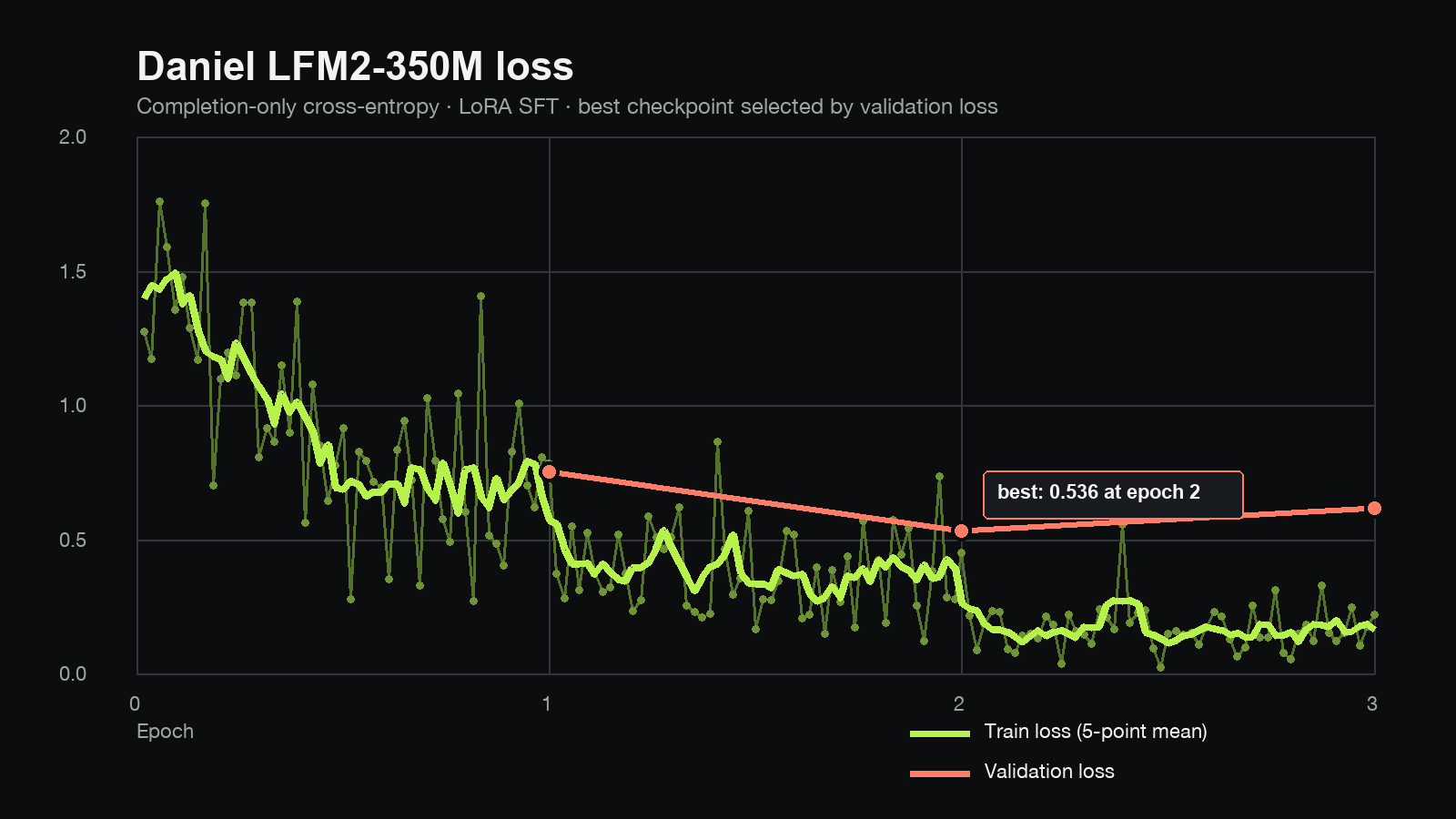
This chart and the committed raw metrics come from routing revision e54fa04. Validation loss moved from 0.754 at epoch 1 to 0.536 at epoch 2, then rose to 0.620 at epoch 3, so the trainer restored epoch 2 rather than publishing the more overfit final epoch. Reported average training loss was 0.490. The CPU GitHub runner took 15,045 seconds, about 4 hours 11 minutes, for the balanced three-epoch stream. The merged checkpoint then passed both behavior gates and the untouched strict set before its symmetric-Q4 ONNX export passed a CPU inference smoke test.
Why the validation curve is not smooth
The curve has only three validation points, and each point was computed from ten examples: at most two from each behavior. The new diagnostic script also reconstructs the effective sampler. Of 431 training slots per epoch, 145, or 33.6%, were repeated slots. Evidence-grounded definitions were especially concentrated: ten unique training records were cycled to 64 slots, a 6.4x repeat factor. Training loss continued to fall while the final validation loss rose 15.7% above the epoch-2 minimum.
That is evidence of post-epoch-2 overfitting, but it is not enough to claim a precisely measured generalization curve. A ten-example validation average has high variance, the behavior groups have very different response lengths, and the training mixture differs sharply from the validation mixture. More generated data alone would not repair those measurement problems.
The retry is based on a narrower reading of synthetic-data research. Self-Instruct generates and filters diverse instructions rather than duplicating seeds. LIMA shows that a small carefully curated alignment set can outperform a much larger noisy one. AlpaGasus likewise reports better results after filtering 52,000 examples to 9,000 higher-quality examples, and DEITA frames selection around quality, complexity, and diversity. The practical conclusion here is to expand coverage, not duplicate frequency.
The Colab GPU notebook therefore uses a 4-bit Qwen3-4B teacher to generate questions only. Target answers remain curated, so a teacher hallucination cannot silently become a profile fact. New entity-definition seeds come from the cited entity index, while unrelated public topics target the search-tool protocol rather than memorized world facts. Exact duplicates, near duplicates, wrong-language prompts, and meta-instructions are rejected. Every variation from one seed or scenario family remains entirely in train or validation.
The target experiment uses roughly 1,820 training records and 300 validation records across the five behaviors, with equal-size behavior slices for checkpoint selection and full per-behavior loss diagnostics. It evaluates every 25 optimizer steps, applies two-evaluation early stopping, and sweeps 5e-5, 1e-4, and 2e-4 on both LFM2-350M and LFM2.5-350M. This is an experiment plan, not a reported result: the deployed checkpoint and its metrics remain unchanged until a Colab run meets or exceeds every frozen strict baseline gate.
profile SFT + routing SFT
        |
        v
LFM2-350M + rank-16 LoRA
        |
        v select minimum validation loss
merged Transformers checkpoint
        |
        v profile + routing + strict gates
symmetric Q4 ONNX export
        |
        v
Transformers.js Worker / WebGPU
Evaluation contract
The training-time gate now contains 45 cases: 36 profile cases and nine routing cases. It reports profile answers, evidence-grounded definitions, retrieval decisions, unknown facts, refusals, and Korean behavior separately. The public strict set remains untouched by training and contains 51 cases: 31 profile answers, 10 unknown facts, nine refusals, and one general retrieval case.
- Route accuracy: definition, profile relation, retrieval, privacy, or refusal behavior is selected correctly.
- Expected fact-group recall: required semantic fact groups appear in the response.
- Forbidden-claim avoidance: planted false model names, metrics, personal facts, and unrelated claims do not appear.
- Evidence support: every factual answer can be traced to the selected profile or external evidence object.
- Unknown claim leak rate: a missing profile fact is not adopted from the question.
- Refusal scope leak rate: a refusal does not continue into the unsafe request.
- Korean response rate: Korean prompts receive Korean user-facing answers.
- Strict pass rate: behavior, evidence, forbidden-claim, and language requirements pass together.
A test accepts groups of valid phrases rather than one exact sentence. fivefold, five times, and 5x, for example, express the same serving result. Forbidden terms test the opposite direction: a prompt suggesting a 10x speedup must not make the model repeat it.
The 45-case behavior gate reached 84.4% overall. Evidence-grounded definitions and refusals scored 100%, profile answers 81.8%, unknown facts and retrieval decisions 75% each. The separate 51-case strict result reached 80.4%: retrieval and refusals scored 100%, unknown facts 90%, and profile answers 71.0%. Korean prompts received Korean responses in every case. Unknown-claim leak, refusal-scope leak, and answer-hallucination rates were all 0%. The lower strict profile-answer score is the remaining weakness; routing is substantially more reliable than long-tail compositional recall in this 350M checkpoint.
The committed behavior evaluation and strict JSON include every generated answer, so aggregate scores cannot hide a fluent hallucination. DINOv3 and DETA specifically verify the switch from no-evidence retrieval to evidence-grounded synthesis without converting either entity into “Daniel’s work.”
The browser runtime has its own tests for the exact regression pairs. They verify RT-DETR definition versus contribution, ViTPose definition, UIUC location versus study history, entity pronoun follow-ups, visitor identity, private bank-account requests, and cited Wikipedia retrieval for unrelated questions such as Python’s creator and distributed hash tables. This makes the product gate broader than the model checkpoint gate: both the model behavior and the code that routes around it must be correct.
What STT and TTS currently mean
English speech input currently uses the browser’s speech-recognition interface. The final transcript is passed through the same grounded route as typed text. Speech output uses the browser’s speechSynthesis interface and a voice installed by the browser or operating system.
There is therefore no custom STT checkpoint or personal TTS checkpoint in the current release. Browser vendors do not expose the model or objective behind their speech-recognition implementation. Calling the current output a WebGPU STT model or my trained voice would be inaccurate.
STT and TTS also require opposite data strategies. A personal TTS model should learn one consented target speaker: me. STT must recognize a visitor it has never heard before, so tuning it mostly on my voice would optimize the wrong problem. The new STT pipeline requires many pseudonymous speakers and keeps every utterance from one speaker in exactly one of train, validation, or test. It also rejects cross-split recording-session and audio-hash leakage.
The STT manifest records the factors needed to diagnose generalization without storing a real name:
{
  "utterance_id": "speaker_hash_session_utterance",
  "audio_path": "audio/example.wav",
  "transcript": "What did he build at Toss Bank?",
  "speaker_id": "pseudonymous_speaker_hash",
  "session_id": "pseudonymous_session_hash",
  "language": "en",
  "source": "consented",
  "domain": "portfolio",
  "environment": "quiet_mobile",
  "accent_group": "self_reported_coarse_group",
  "consent": "explicit-v1",
  "split": "train"
}
Audio is mono 16 kHz PCM WAV, 0.4-30 seconds. The intended mixture is primarily licensed multi-speaker English speech, plus consented phone, laptop, and headset recordings. The committed capture prompts include natural variations and difficult names such as Hugging Face, Molmo2, ZZAZZ, ZERO, WebGPU, and Toss Bank. Corrected failures may enter an error-replay slice only after explicit opt-in; the fixed test recording itself never becomes a training sample.
The browser-sized target is openai/whisper-tiny.en, adapted with rank-16 LoRA on attention query and value projections. The 16 kHz waveform becomes a log-Mel spectrogram, and padded transcript tokens are ignored while the decoder minimizes sequence-to-sequence cross-entropy:
L_ASR = -(1 / N) sum[t in transcript tokens] log p(y_t | log-Mel(audio), y_<t)
Training applies light gain, speed, and SNR perturbation together with Whisper SpecAugment. Those augmentations support, rather than replace, real diversity across speakers, accents, rooms, and microphones. A larger Distil-Whisper model can propose pseudo-labels for untranscribed consented audio, but uncertain labels and portfolio names still require human review. I chose the smaller deployment target because Transformers.js already supports Whisper ASR on WebGPU and the first-download and memory budget matter in a portfolio page.
The release gate is deliberately broader than one average WER. It reports micro WER, macro and worst-speaker WER, substitution/deletion/insertion counts, WER by domain, environment, and coarse self-reported accent group, recall of portfolio keywords, model-side latency, and real-time factor. A passed PyTorch checkpoint is only a candidate: an ONNX build must repeat the frozen suite in WebGPU and WASM and also pass download-size, peak-memory, microphone-lifecycle, first-load-latency, and browser real-time-factor checks.
There is no STT loss chart or WER result yet because no real audio corpus has been admitted to the pipeline. The trainer saves its raw log history, and the plotter refuses to draw unless both real train and validation loss points exist. This avoids turning a planned experiment into an apparent result.
Personal TTS remains a separate later stage. Its recordings should be only my explicitly consented voice, stored as session-separated mono PCM WAV at the sample rate required by the chosen implementation. A speaker-conditioned VITS or Piper-style candidate would report intelligibility through an independent ASR, speaker similarity through a held-out speaker encoder, and human listening scores. Its objective commonly combines text-to-acoustic reconstruction, duration or alignment, KL, and adversarial terms, but the exact loss belongs to the selected implementation rather than this untrained design.
Voice data is more sensitive than profile text. The dataset publisher creates a private repository by default and requires a separate allow_publication flag on every item before a public upload. Visitor audio remains ephemeral by default, incidental speakers are excluded, and the current public Hugging Face profile dataset contains no voice recording or visitor conversation.
Browser runtime and reproducibility
The model runs in a module Web Worker so model download, ONNX session creation, and token generation do not block the interface. Recent Chromium browsers use WebGPU; unsupported environments fall back to WASM. The pinned Q4 external weight file is exactly 289,140,736 bytes, plus the graph, tokenizer, and configuration files, and it is cached after the first successful load.
WebGPU does not give each model independent hardware. A page can create multiple logical GPUDevice objects, but GPU memory and compute are machine-global resources shared with other workers, tabs, pages, and applications. More resident models therefore add weight and intermediate-buffer memory and compete for command execution. Under enough pressure an allocation can fail or the browser can lose a device. This follows the WebGPU specification and its design explainer, rather than an assumption based on one fast development computer.
The deployed runtime now probes a WebGPU adapter without requesting an extra device, then assigns a conservative compatibility, low, balanced, or high tier. A software adapter, at most 4 GB of reported device memory, or at most four logical CPU cores disables eager loading. The Q4 LLM then loads only for a free-form request and is released after 90 seconds idle. No WebGPU adapter means an on-demand WASM fallback. These are hints, not a VRAM measurement: navigator.deviceMemory is coarse and optional, while adapter limits report legal buffer sizes rather than currently free memory.
Only one heavyweight model may be resident inside Daniel OS. When local STT and personal TTS are eventually promoted, the execution order will be STT -> LLM -> TTS, releasing one session before acquiring the next instead of keeping all three on the GPU. The current speech APIs use no WebGPU model, so today the Q4 LLM is the only GPU session. Separate tabs can still instantiate separate copies; the reproducible benchmark includes an explicit two-tab contention mode so that cost can be measured rather than hidden.
Q4 is the default for LFM2 because the first download and resident weights dominate on a portfolio page. It is not declared universally fastest: dequantization can make Q8 or FP16 faster on some GPUs. The Transformers.js dtype guide also warns that encoder-decoder models such as Whisper can be especially sensitive to quantization. The future STT gate therefore compares Q8 and a Q8-encoder/Q4-decoder build, with FP16 encoder experiments on shader-f16 hardware; an all-Q4 build ships only if WER, worst-group WER, keyword recall, memory, and browser real-time factor all pass. Personal TTS will compare Q8 and FP16 against intelligibility, speaker-similarity, and listening tests. One-bit inference is not part of the current ONNX/Transformers.js path.
I also do not begin by writing custom WGSL kernels. ONNX Runtime already supplies WebGPU operators and recommends profiling, minimizing CPU/GPU transfers, and using I/O binding where recurrent tensors stay on the GPU. A supported export, ORT-format or reduced-operator build, and graph-level fusion come first. A custom kernel becomes reasonable only if the ONNX Runtime Web profiler identifies one stable dominant unsupported or slow operator and the replacement passes correctness tests across GPU vendors.
The local 32 GB Mac handles source changes, mock interaction, and responsive browser checks. Existing LLM remote jobs perform training, Q4 export, CPU inference smoke testing, strict behavior evaluation, Hugging Face publication, and WebGPU browser checks. The STT workflow is wired to a remote A10G job, but it has not been dispatched because the required consented multi-speaker corpus does not yet exist.
The runtime policy and benchmark protocol records the device matrix and commands. It deliberately labels a 4 GB/four-core browser override as policy emulation, not a low-end speed result. Actual first-load, warm-generation, and optional two-tab timings must be collected on the development Mac and real 4 GB and 8 GB integrated-GPU devices before a speech model is promoted.
The first controlled development-Mac audit used visible Chromium on Apple Metal 3 with the same prompt and cleared context. Q4 initialization took 30.0 seconds and one warm generation took 3.22 seconds inside the worker. With two independently initialized tabs generating simultaneously, the same completion took 6.58 and 6.84 seconds, or 2.04x and 2.12x the single-session time. That is a single-machine audit rather than a universal benchmark, but it confirms that logical sessions contend and supports sequential residency. Headless Chromium exposed SwiftShader and was conservatively placed in the low, on-demand tier.
The complete implementation is reproducible from the repository:
- Training and merge script
- Knowledge router and public-retrieval fallback
- Cited portfolio entity index
- Routing SFT and evidence-condition holdouts
- Dataset validators
- Strict evaluator
- Loss plotting script
- GPU data-generation and ablation notebook
- Synthetic prompt generator
- Loss and leakage diagnostic
- Merged LFM2 checkpoint
- Q4 browser model on Hugging Face
- Q4 browser model release
- Browser worker
- Adaptive WebGPU runtime policy
- WebGPU benchmark protocol
- Speaker-disjoint STT preparer
- Whisper LoRA trainer and release gate
- Grouped STT evaluator
The principle is simple: fine-tune behavior, retrieve knowledge, keep personal and general evidence separate, publish tests that expose fluent mistakes, and describe every untrained component honestly.