Basically estimation and tracking is easy terminology by understanding definition of respective keywords. Additionally, in a viewpoint of each results, both may same exactly although have different meaning. There are two methods of tracking human pose, one is top-down, the other is bottom-up. In my comprehension estimation is usually used in an image and tracking is used in a video.
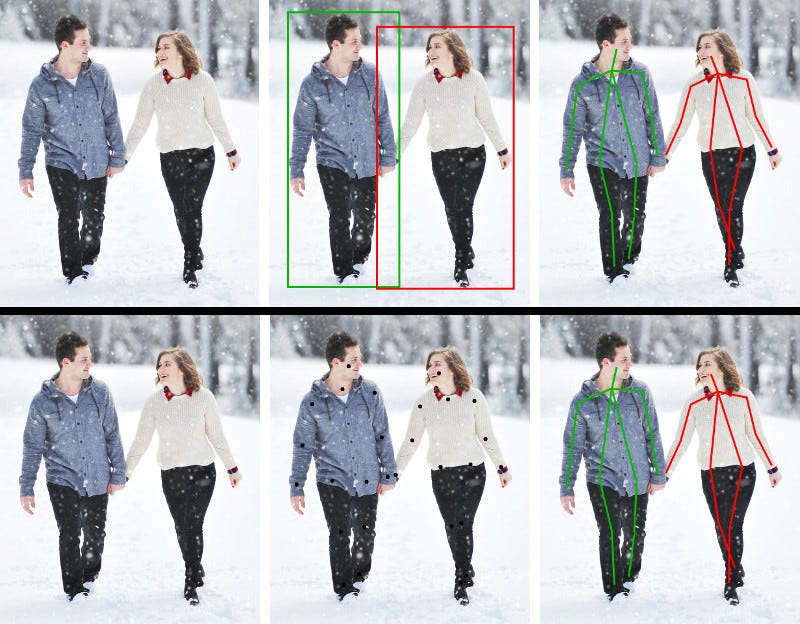
Top-down method is basically detecting boxes first and annotate the keypoints with connecting line to draw like pose in the boxes. Bottom-up method is detecting all the keypoints first and showing the result.
 .
According to [Pose Flow: Efficient Online Pose Tracking from Shanghai Jiao Tong University], top-down method is much more effective in both accuracy and tracking speed. In a definition of accuracy, there are two checking systems, which are mAP(mean average precision) and MOTA(multiple object tracking accuracy, not precision) respectively.
New Terminology
- Improved RMPE (Regional Multi Person Estimator) : estimator
- PF - Builder (Pose Flow Building) According to below figure (2)
- PF NMS (Pose Flow non maximum suppersion) : reducing redundant link from adjacent frame
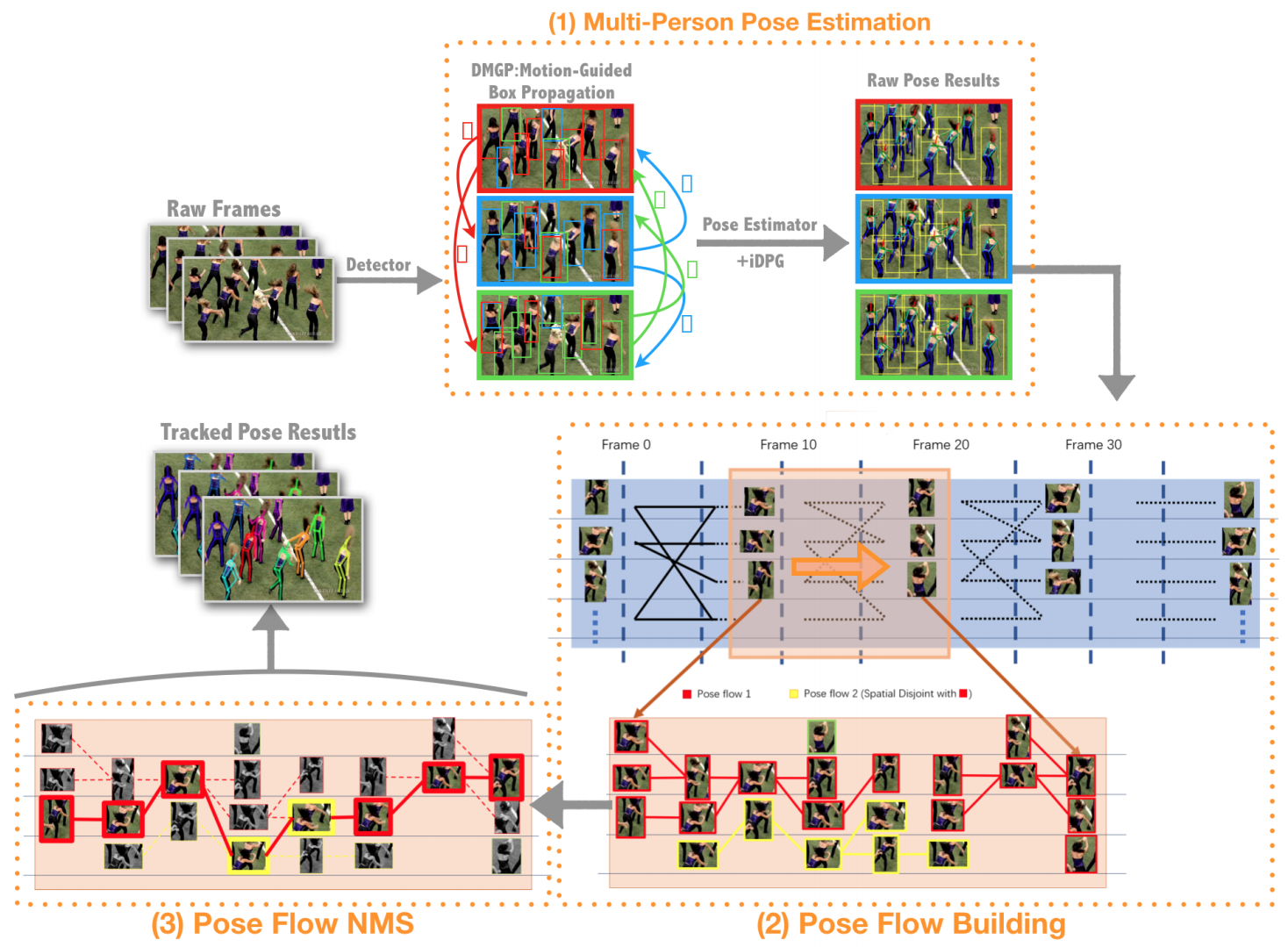 .
In (2) it calculates Intra-Frame Pose Distance based on [RMPE: Regional Multi-Person Pose Estimation].
\(P_i\) is a pose in a frame, i indicates the number of instances in one frame. It assumes that pose has m joints in one pose with denoted as \({\langle k^1_i, c^1_i \rangle,...,\langle k^m_i, c^m_i \rangle}\). \(k\) represent the position of joints and \(c\) is the score of prediction in \(i^{th}\) frame with m different keypoints.
Distance is denoted as \(d_{pose}(P_i,P_j)\) and assuming \(B_i\) is standing for box of \(P_i\) \(K_{sim}(P_1,P_2|\sigma_1) = \begin{cases} \sum_{n}tanh \frac{c_1^n}{\sigma_1} tanh \frac{c_2^n}{\sigma_1} & {p_{2}^{n}} \text{is within} {B(p_{1}^{n})} \\ 0 & \text{otherwise} \end{cases}\)
Question: Does tracking algorithm is for more precise accuracy instead of lightweightning of model?
Reference
[1] https://arxiv.org/pdf/1802.00977.pdf
[2] https://arxiv.org/pdf/1712.09184.pdf
[3] https://medium.com/@jonathan_hui/map-mean-average-precision-for-object-detection-45c121a31173
[4] https://motchallenge.net/results/3D_MOT_2015/?chl=3&orderBy=MOTA&orderStyle=DESC&det=Public
[5] https://arxiv.org/pdf/1612.00137.pdf
GitHub
[1] https://github.com/YuliangXiu/PoseFlow
기본적으로 estimation과 tracking은 각 키워드의 정의를 이해하면 쉬운 용어입니다. 또한 결과의 관점에서 보면 두 가지는 의미가 다르지만 결과는 완전히 같을 수도 있습니다. 사람의 pose를 tracking하는 방법에는 두 가지가 있는데, 하나는 top-down이고 다른 하나는 bottom-up입니다. 제가 이해하기로는 estimation은 주로 이미지에서, tracking은 비디오에서 사용됩니다.
Top-down 방식은 먼저 box를 검출한 뒤, box 안에서 keypoint를 표시하고 선으로 연결하여 pose를 그리는 방식입니다. Bottom-up 방식은 먼저 모든 keypoint를 검출한 뒤 결과를 보여주는 방식입니다.
.
[Pose Flow: Efficient Online Pose Tracking from Shanghai Jiao Tong University]에 따르면, top-down 방식이 accuracy와 tracking 속도 모두에서 훨씬 효과적입니다. Accuracy의 정의에는 두 가지 평가 지표가 있는데, 각각 mAP(mean average precision)와 MOTA(multiple object tracking accuracy, precision이 아님)입니다.
새로운 용어
- Improved RMPE (Regional Multi Person Estimator) : estimator
- PF - Builder (Pose Flow Building) 아래 그림 (2) 참고
- PF NMS (Pose Flow non maximum suppersion) : 인접 frame 간의 중복된 link를 줄임
.
(2)에서는 [RMPE: Regional Multi-Person Pose Estimation]을 기반으로 Intra-Frame Pose Distance를 계산합니다.
\(P_i\) 는 한 frame 내의 pose이며, i는 한 frame 내 instance의 번호를 나타냅니다. 하나의 pose가 m개의 joint를 가진다고 가정하며, 이를 \({\langle k^1_i, c^1_i \rangle,...,\langle k^m_i, c^m_i \rangle}\)로 표기합니다. \(k\)는 joint의 위치를 나타내고, \(c\)는 m개의 서로 다른 keypoint를 가진 \(i^{th}\) frame에서의 prediction score입니다.
Distance는 \(d_{pose}(P_i,P_j)\)로 표기하며, \(B_i\)는 \(P_i\)의 box를 나타낸다고 가정합니다. \(K_{sim}(P_1,P_2|\sigma_1) = \begin{cases} \sum_{n}tanh \frac{c_1^n}{\sigma_1} tanh \frac{c_2^n}{\sigma_1} & {p_{2}^{n}} \text{is within} {B(p_{1}^{n})} \\ 0 & \text{otherwise} \end{cases}\)
질문: tracking 알고리즘은 모델 경량화보다는 더 높은 accuracy를 위한 것일까요?
참고 문헌
[1] https://arxiv.org/pdf/1802.00977.pdf
[2] https://arxiv.org/pdf/1712.09184.pdf
[3] https://medium.com/@jonathan_hui/map-mean-average-precision-for-object-detection-45c121a31173
[4] https://motchallenge.net/results/3D_MOT_2015/?chl=3&orderBy=MOTA&orderStyle=DESC&det=Public
[5] https://arxiv.org/pdf/1612.00137.pdf
GitHub
[1] https://github.com/YuliangXiu/PoseFlow